The beater sits outside the Dhanraj Ranmal Bhatia sweet shop on a stone block, cushioned by a folded hessian sack. He raises the giant wooden pestle high above his head, straight-armed, muscles taut, the saffron-yellowed end pointing forwards. As he brings it down he aligns it with the stone mortar at his feet, gripped between his knees. He pounds the aromatic golden mixture. The dull thud reverberates through the ground beneath my sandals. Each time before beginning its descent the pestle is poised, motionless for a second. The man’s eyes never waver from the mortar. Wafts of cardamom mingle with the smell of sunburnt dust in 47 degrees, steaming cow turds, human sweat and next door’s simmering pots of gobi musallum, dahl and palak paneer. The beater’s grey cotton shirt has been ripped to short sleeves. His hair sticks to his forehead and rivulets of sweat are filtered through his lashes before continuing down his face and neck. His heavy brows are puckered in concentration. He pays no attention to the colourful saris swishing past on silver-bangled ankles, or to customers stopping to select sweets from the glass shop-front counter alongside him.
Finally, it is ready. The beater puts his pestle aside. A boy in a red and blue checked shirt helps him empty the mixture into a tarnished copper bowl. The each grip a looped handle and carry it to a newspaper covered block beside the counter.
They perch opposite each other, the bowl stabilised in an old motor bike tyre. They roll large globs of the sticky mixture into perfect globes between their palms. Their fingers blur. Their forearm veins stand out like tree roots above the ground.
The sweet seller behind the counter glances our way and smiles. “Wedding sweet, our speciality. Famous all over Rajasthan. You should try one.” It comes out almost like a song.
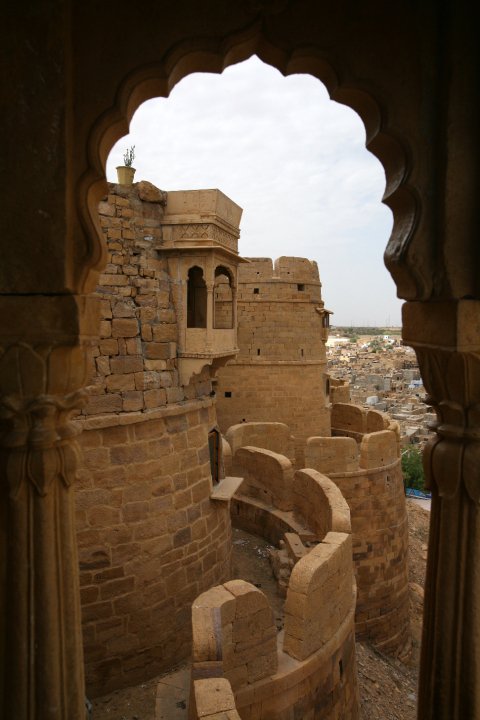
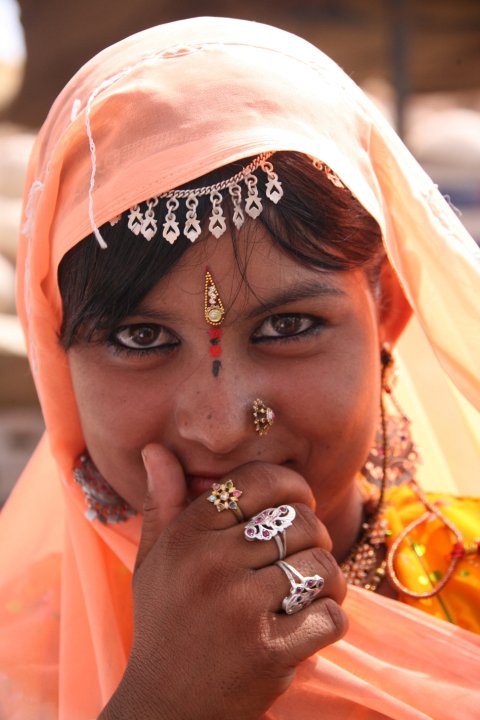
The rounded-belly-shaped walls of the golden sandstone fort of Jaisalmer tower above the little sweet shop. Not long ago the whole city was housed within those walls but it burst at its seams. The winding streets, like umbilical cords, crept out over the desert sands. Around the corner from the sweet shop is an arched entrance to the fort, guarded by a group of Rajasthani women, their eyes glinting as brightly as the jangly anklets they sell. They do not give up. They call and screech, rainbow lorikeets of the Thar desert.
The sweet is delicious. Saffron and cardamom, pressed sugar cane, perhaps ground almonds, or roasted semolina. I am not sure. The sweet seller laughs when I ask. “People would kill for that information. And I would be out of business.” He laughs for a long time.
An auto rickshaw swerves to avoid a cow lounging in the middle of the dirt road, flicking flies with its tail. A group of young women step under the faded awning of the tailor’s shop to get out of its way, their chatter unbroken. They continue, the sunlit silver and gold borders of their saris softly sweeping the dust before them.
The Singer treadle sewing machine whirrs as a wiry bare foot presses the pedal. The tailor’s head nods in time. He snips the thread, inspects the shirt and folds it neatly. He motions to the sweet seller, who places a single wedding sweet into a twist of newspaper. The boy takes it to him.
An apparition in a clean white kurta and loose-fitting salwar, eyes fixed straight ahead, floats past slowly on his motorbike. It is Swaroop, from a textile handcraft emporium two blocks away. He is pretending not to be spying. He thinks we are his.
The flat rooftops of the city spread out below the fort were rarely still. They were a platform for kite-flying, drying laundry, animated debates, outdoor eating, sleeping and all sorts of other activities.
Amina concentrated on the ball, tense as a tiger ready to pounce on dinner. The only movement came from the tunic tails of her Punjabi dress, lifting in the breeze. As her young nephew Atul bowled, she sprang sideways into the ball’s path and whacked it into the metre and a half high concrete wall of the rooftop restaurant. Her eyebrows relaxed and she grinned as he scurried to retrieve it.
“Are you ready?” He practised his English.
“Always.”
This time it flew over the wall and the boy raced down the steps to find it before the neighbours’ kids did. Puffing, he returned holding it aloft.
“I had to beg Narayan for it. He said you have to bring him some halwa or shandesh to pay for it.”
“Ha! Why should I pay for my own cricket ball? Tell me that.”
Amina was an ex-officer of the Indian army. She had retired just two years earlier to run a restaurant and a women’s guesthouse with her sister in Jodhpur, Rajasthan. She was also involved with a women’s refuge and had a seat on the local council.
I learnt to love cricket in the army,” she told me. “We played whenever there was nothing to do. It’s the only thing I miss.”
Waving to Atul to bowl, she took her position and once more tried to break concrete with a rubber ball.
Steam rose from my bowl. Slabs of soft white cheese lay submerged in a bog of slimy spinach sauce, spiced to defy expectation.
I watched Amina’s ponytail sweeping the air. Behind her the Blue City’s rooftops were coming to life with children tossing their homemade kites to the breeze. The boys on the nearest roof deliberated ambush tactics as they eyed a high-flying lone red sniper.
High in front of her, perched on a cliff, the red sandstone Mehangarh Fort owned the skyline. Its sacred Kites, known as Cheels, rode the currents undaunted by their paper and stick counterparts. The eggshell-blue city of Jodhpur crouched at Mehrangarh’s feet. A stone footpath, a back route, snaked from the restaurant up to the first of the fort’s seven gates.
Revenge, scandal and intrigue seep from the pores of the burnished walls of the fort, often called The Citadel of the Sun. The fort was founded in 1459 A.D. by the Maharaja Rao Jodha, fifteenth of the Rathore dynasty, which ruled the surrounding Land of Death from the thirteenth until the twentieth century. The Rathores believe they are direct descendants of the sun. But in many ways it is the sun itself which rules this barren landscape. Trying to thwart a curse placed on Jodha – that his citadel would forever suffer a scarcity of water – he persuaded a man called Rajiya to let himself be buried alive in the foundations of the fort in return for a promise that his family would be looked after through the generations. True to he promise, Rajiva’s descendants still enjoy the current Maharanja’s favour, living in an estate called Rajiva’s Garden. Perhaps it was his bones which gave the fort the strength to withstand every siege ever mounted against it.
And perhaps it was the hill itself, on which the fort was built, which encouraged inopportune flight. Known variously as Bhakurcheeria, the Mountain of Birds, or Bakharchiriya, the Bird’s Nest, or Cheeriatunk, the Bird’s Beak, the hill’s original inhabitant was the hermit Cheeria Nathji, Lord of the Birds – the man who had cursed Jodha.
“Did you know that Maharaja Maan Singh dropped his Prime Minister from the ramparts? He fell over 120 metres and was completely squashed.”
Atul was hunting for the ball under the tables as I ripped off pieces of chapatti to mop the last vestiges of palak paneer from my bowl.
“And Prince Jaswant Singh tossed his mistress out the window. The problem was she was also his father’s mistress. He found out, you see.”
Visitors could be excused for thinking of the fort’s history as a series of plummeting bodies.
Atul’s mother brought him a samosa, the sun bouncing off her bangles. She said something to him in Hindi and smiled, stroking his cheek once with a finger.
“She said I talk too much. But I was top of my class in history. Another Maharaja, Rao Ganga, he fell to his death too. People say he was smoking opium.”
A young Swiss traveller was leaning over the perimeter wall of the rooftop, adjusting the lens of her camera. She stiffened, then turned to beckon Amina.
“That’s him. I’d hoped to see him again and there he is.”
“Are you sure it’s him?” asked Amina.
“Ninety-five percent, but I want to get a closer look.”
She abandoned her camera, bag, sandals and Lonely Planet guidebook and hurried down the steps while Amina watched, frowning.
A group of three youths in jeans faced each other, talking, at the start of the footpath. One was tucking his shirt in, and smoothing his hair behind his ears. The young traveller walked past them, crossing the narrow street as if going to the guesthouse opposite. She turned her face towards them to get a better look, then doubled back, striding right into their circle and eyeballing the Bollywood-handsome one. The traveller was tall, her knee-length shorts revealing sun-browned muscular calves.
“It was you, wasn’t it? She directed to the youth.
It was clearly not a question. Amina, listening, sucked her breath in, then slipped her jandals on and ran down the steps, still holding the cricket bat. The youth spun on his heels, arms waving like an albatross as he fled along the narrow street, which ran around the base of the hill. His mates dissolved into the gathering crowd and dust. The Swiss Miss followed, a tangle of curly brown hair escaping her clip as she gained on him, in the obstacle course of dogs, chickens, rubbish and bicycles. Amina’s pajama-like trousers flashed through the throng. She didn’t stop as she yelled something through an open window. A man in a singlet rushed out the door and joined the chase. Men and women shouted and pointed in three different directions. The children abandoned their games to race after the chasers – all except a little girl in a pink ruffled dress with kohl framing her eyes, who squatted in the gutter with both arms around a squawking duck.
The man who had joined the chase was an off-duty policeman. He hadn’t managed to catch the youth, but now knew who he was.
“I just want him to be shamed, in front of his mothers and his sisters,” said the young traveller.
“He will be,” said Amina. “Our young men would never dare to do that to an Indian woman.”
On the path to the fort he had unsuccessfully tried to hire himself out to the traveller as a guide. He had then groped her crotch before racing back down the path.
“I was so shocked I couldn’t do anything in time.”
There are handprints on the walls near the innermost gate of the fort, where some of the queens left their mark as they walked their last steps to the funeral pyre of a Maharaja, to share his flames in the Rajasthani tradition of sati. When Maharaja Ajit Sing died, six queens and fifty eight concubines burnt alongside him.
Amina, as beautiful as the warrior queens depicted in miniature paintings, had not married.
“I like to be free.” She puckered her lips as the ball whooshed over the wall. “You know, there are some women who still think sati’s the best option.”







 That's about the size of it