The beater sits outside the Dhanraj Ranmal Bhatia sweet shop on a stone block, cushioned by a folded hessian sack. He raises the giant wooden pestle high above his head, straight-armed, muscles taut, the saffron-yellowed end pointing forwards. As he brings it down he aligns it with the stone mortar at his feet, gripped between his knees. He pounds the aromatic golden mixture. The dull thud reverberates through the ground beneath my sandals. Each time before beginning its descent the pestle is poised, motionless for a second. The man’s eyes never waver from the mortar. Wafts of cardamom mingle with the smell of sunburnt dust in 47 degrees, steaming cow turds, human sweat and next door’s simmering pots of gobi musallum, dahl and palak paneer. The beater’s grey cotton shirt has been ripped to short sleeves. His hair sticks to his forehead and rivulets of sweat are filtered through his lashes before continuing down his face and neck. His heavy brows are puckered in concentration. He pays no attention to the colourful saris swishing past on silver-bangled ankles, or to customers stopping to select sweets from the glass shop-front counter alongside him.
Finally, it is ready. The beater puts his pestle aside. A boy in a red and blue checked shirt helps him empty the mixture into a tarnished copper bowl. The each grip a looped handle and carry it to a newspaper covered block beside the counter.
They perch opposite each other, the bowl stabilised in an old motor bike tyre. They roll large globs of the sticky mixture into perfect globes between their palms. Their fingers blur. Their forearm veins stand out like tree roots above the ground.
The sweet seller behind the counter glances our way and smiles. “Wedding sweet, our speciality. Famous all over Rajasthan. You should try one.” It comes out almost like a song.
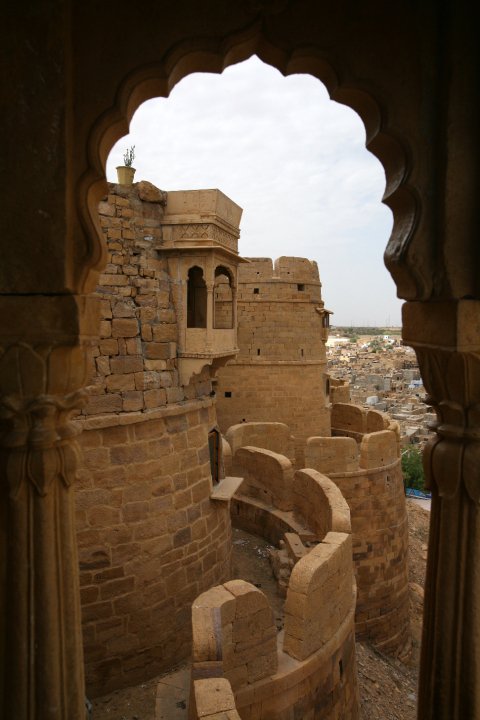
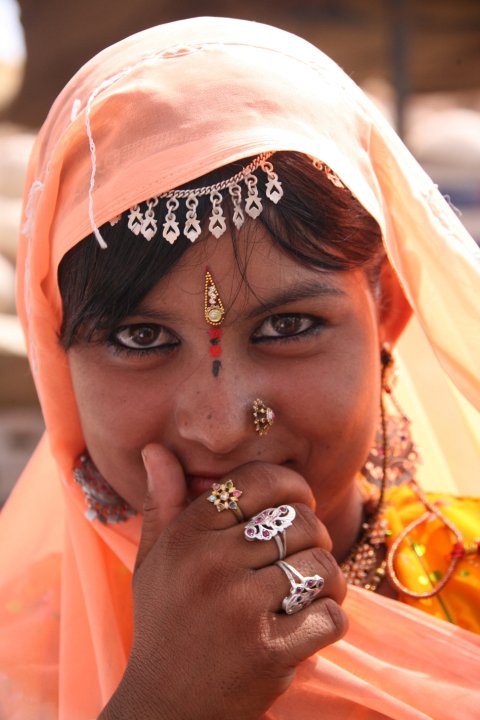
The rounded-belly-shaped walls of the golden sandstone fort of Jaisalmer tower above the little sweet shop. Not long ago the whole city was housed within those walls but it burst at its seams. The winding streets, like umbilical cords, crept out over the desert sands. Around the corner from the sweet shop is an arched entrance to the fort, guarded by a group of Rajasthani women, their eyes glinting as brightly as the jangly anklets they sell. They do not give up. They call and screech, rainbow lorikeets of the Thar desert.
The sweet is delicious. Saffron and cardamom, pressed sugar cane, perhaps ground almonds, or roasted semolina. I am not sure. The sweet seller laughs when I ask. “People would kill for that information. And I would be out of business.” He laughs for a long time.
An auto rickshaw swerves to avoid a cow lounging in the middle of the dirt road, flicking flies with its tail. A group of young women step under the faded awning of the tailor’s shop to get out of its way, their chatter unbroken. They continue, the sunlit silver and gold borders of their saris softly sweeping the dust before them.
The Singer treadle sewing machine whirrs as a wiry bare foot presses the pedal. The tailor’s head nods in time. He snips the thread, inspects the shirt and folds it neatly. He motions to the sweet seller, who places a single wedding sweet into a twist of newspaper. The boy takes it to him.
An apparition in a clean white kurta and loose-fitting salwar, eyes fixed straight ahead, floats past slowly on his motorbike. It is Swaroop, from a textile handcraft emporium two blocks away. He is pretending not to be spying. He thinks we are his.
 That's about the size of it